How can energy consumption be reduced without increasing travel times, or connected yachts be protected against cyberattacks, and what role will AI play in vessel design? These were just some of the questions addressed at Thursday’s Advanced Yachting Technology Conference, organised by Yacht Club de Monaco as part of the 13th Monaco Energy Boat Challenge. Naval architects, engineers, researchers, industry representatives and digital experts came together for an event highlighting the evolution taking place in the maritime sector. While propulsion remains a key issue, the transition is now driven by a more holistic approach where energy efficiency, digital tools, cybersecurity and new design methods are on the same path
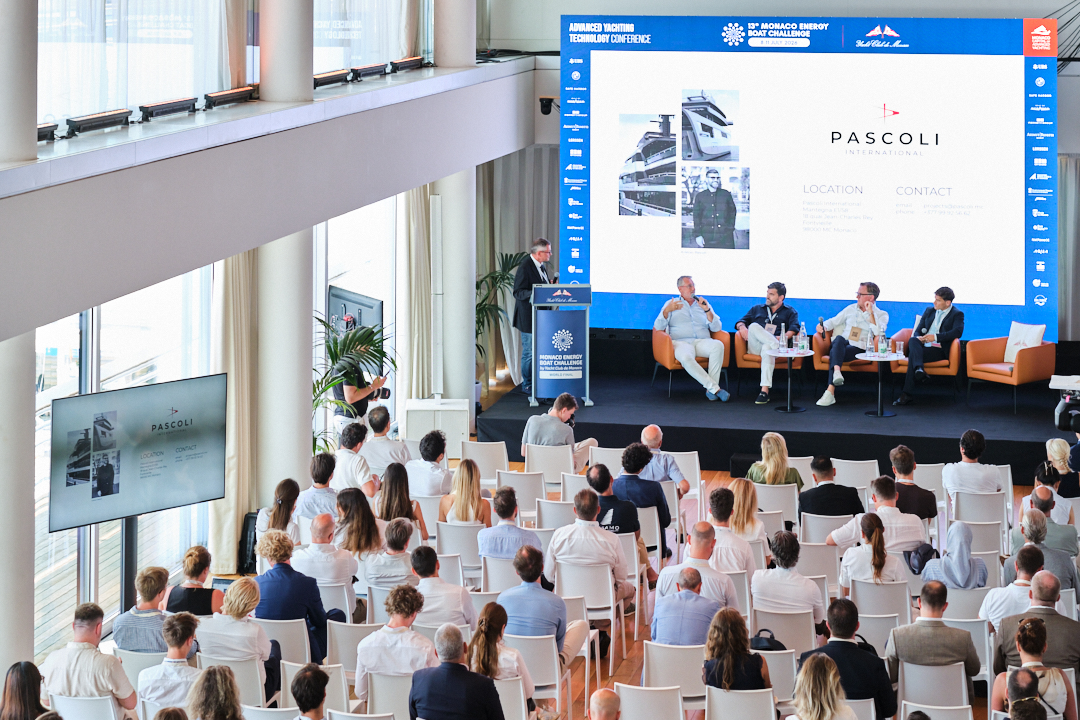
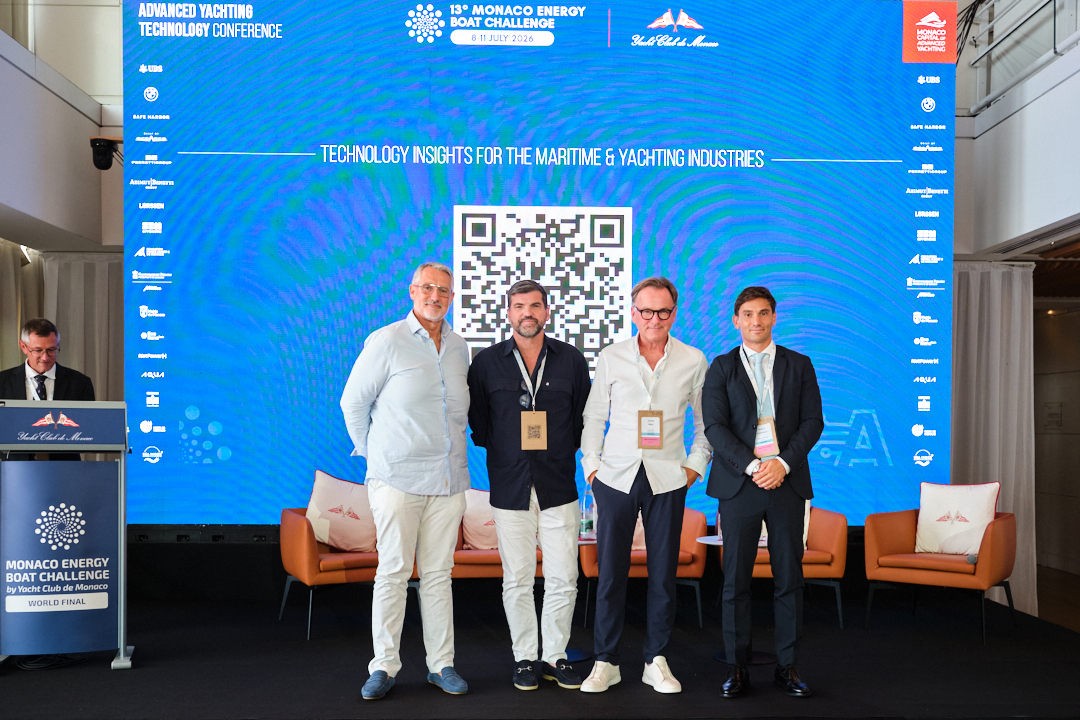
A clear consensus emerged from the presentations that a boat’s performance no longer depends solely on its propulsion system. Discussions addressed yachting’s role in Monaco’s economy, how the sector is adapting to climate change, the energy efficiency improvements driven by new technologies, and the integration of artificial intelligence (AI) into navigation and design tools.
Opening the conference, Cluster Yachting Monaco member, Carlo Torre, highlighted the sector’s economic significance in the Principality. Data compiled by IMSEE, Monaco Statistics Office, reveal that companies involved account for 5.7% of the country’s businesses and generate 9.3% of its revenue. “These figures relate to companies whose activities are almost exclusively linked to the yachting sector. They do not factor in a significant portion of revenue generated by services, which although they may not be specifically designed for yachts are nevertheless provided to them”.
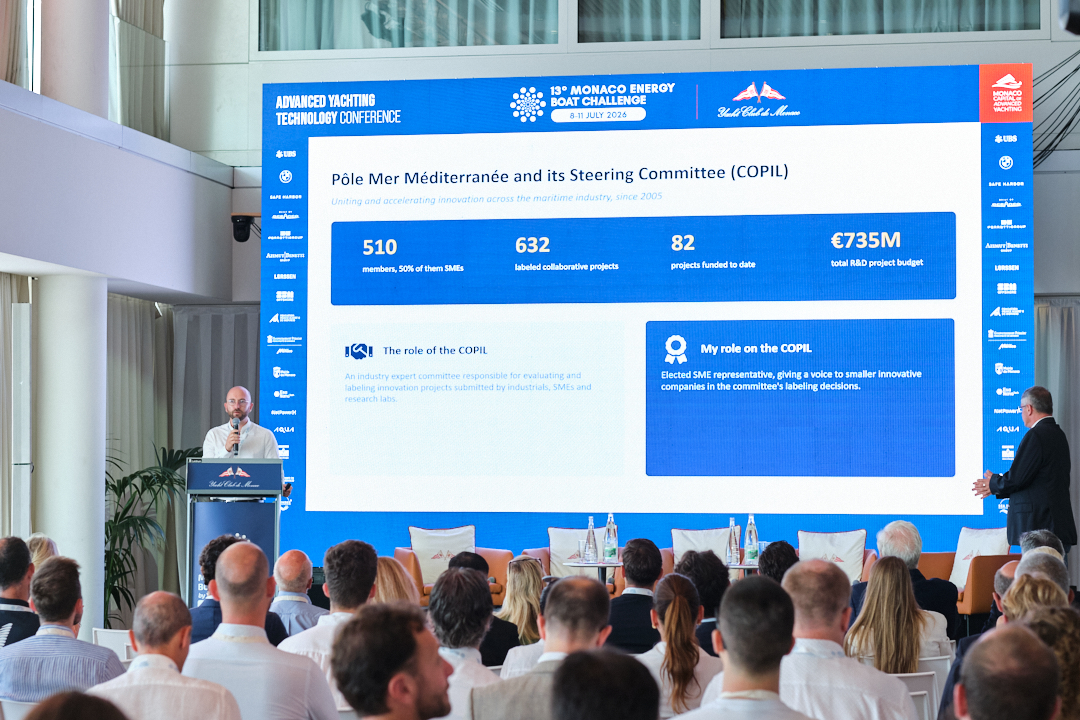
The changes taking place are supported by new industrial capabilities. Clément Rousset, Managing Director of NEPTEC and a member of the Polymeris Méditerranée steering committee, presented this cluster’s competitiveness strategy. It has over 500 members and has awarded its label to more than 600 projects, 82 of which have received funding. It focuses its efforts on three key areas with a national roadmap: Green Ship for decarbonisation, Smart Ship for digitalisation and autonomy, and Smart Yard focused on new materials.
Data collection played a central role in discussions. For Maëlle Truchement, co-founder and CEO of NEMO-Systems, having reliable data is the first step in any decarbonisation strategy. Tools developed by her company make it possible to monitor onboard energy usage, identify the most energy-intensive areas, and support environmental certification processes. “You cannot take action if you can’t measure it. Once you have data, you can see what is consuming energy and how to address it”.
Shipbuilders have already adopted this approach. Iacopo Senarega, R&D Project Manager at Azimut | Benetti Group, explained that research efforts are now focused on improving thermal comfort while also reducing energy consumption. “Thermal comfort is one of the areas we are already working on. For example, we use numerical simulation (CFD) to optimise air conditioning and the actual power required on board”.
Martina Reche-Vilanova, Technical Manager at Southern Spars shares this view, with data gathered from wind propulsion systems now being used to further automate sail adjustments, making them easier to use while also improving the boat’s energy efficiency. “These technologies, such as sail-based navigation systems, really do achieve savings. Indeed, every time you use your sail you aren’t consuming fuel; we call it ‘free fuel.’ You are using green energy and that completely changes the equation”.
Finally, Natalie Quevert, General Secretary of the SEA Index®, an international index that assesses a yacht’s environmental performance using an independent, third-party-verified methodology, has observed a shift in owner expectations. They now seek environmental assessment tools as early as the design phase to anticipate a yacht’s impact and protect its long-term value. “More and more owners are turning to us as early as the design phase,” which she says reflects a growing awareness among owners.
That’s not to overlook the human element. Claire Ferandier Sicard, CEO of ETYC, put the transition in the context of the daily realities for the crew. Environmental solutions on board can only succeed if they integrate seamlessly with existing practices. Reducing environmental impact relies as much on crew training as it does on data collection she says, and the integration of technologies to automate certain tasks without increasing the workload. “We try to avoid adding new tasks for crews. New technologies should support their work and help reduce the number of actions they need to perform”.
The inaugural Digital Yacht Week, organised by YCM in partnership with the Digital Exhibition Group, concluded by presenting its first award. Launched to give young designers a fully digital international platform, the competition invited students to envision the future of yachting through immersive 3D projects. This year, 14 students from six institutions were selected. Showcased online, their projects have already attracted over 9,000 visitors, with an average of ten boats viewed per visitor. “Digital Yacht Week was created with a clear objective: to provide a global platform where the next generation of designers can share their vision of yachting’s future,” explains Dario Reggilli, founder and CEO of the Digital Exhibition Group. The jury awarded the prize to Barcelona-based student Marco Bonfiglio for his OW project, a 31 metre catamaran inspired by Catalan modernist architecture and conceived as a “floating island” dedicated to well-being. His concept reimagines naval design codes by drawing inspiration from Gaudí’s lines while offering an immersive experience centred around passenger comfort.
AI is now making its way into navigation support tools. While not replacing the skipper, it facilitates real-time use of increasing volumes of data to optimise routes based on weather conditions, currents, energy consumption and onboard comfort. The speakers emphasised that these systems are primarily decision-support tools for now, as their adoption largely depends on the crew’s trust.
For Aakash Dua, Business Development Director for Western Europe at DNV, weather routing is no longer solely about safety. New tools aim to balance multiple parameters such as weather conditions, ETA (estimated time of arrival), energy efficiency and passenger comfort. Unlike older models based on fixed curves, current systems constantly adapt to the conditions encountered. “Today, AI-based weather routing performs three roles. The first involves analysing weather conditions and sea states. The second concerns the ETA. The third, currently the most critical, is optimising costs and efficiency”. He adds that these models are constantly evolving thanks to data collected. “Today, they adapt in real-time based on conditions. They learn and they evolve”.
For Nicolas Boulet, Managing Director of Wisamo, smart routing is an additional lever for harnessing the potential of wind-assisted propulsion systems without compromising crew operational constraints. The goal remains to improve performance while keeping travel time close to that of a direct route. “Optimised routing makes it possible to gain 10-15% more wind propulsion without extending the journey time, or doing so only marginally”. In his view, automation is an essential prerequisite for deploying these technologies in the yachting sector.
Misha Vyosokovskiy, Chief Product Officer at Savvy Navvy, believes the main challenge is no longer technological but human. Although solutions exist, their adoption still depends on how much boaters trust them. “We aren’t there yet. You have to make the case. You have to explain why, for example, turning right at a particular moment would be beneficial, etc.”. In his view, AI should primarily enhance the skipper’s or captain’s capabilities, not replace them.
All concluded that despite advances in AI, ultimate responsibility rests with the captain. Systems are improving all the time, but human expertise is essential for interpreting recommendations, balancing comfort, safety and energy efficiency, and making on-the spot decisions in real-life situations.
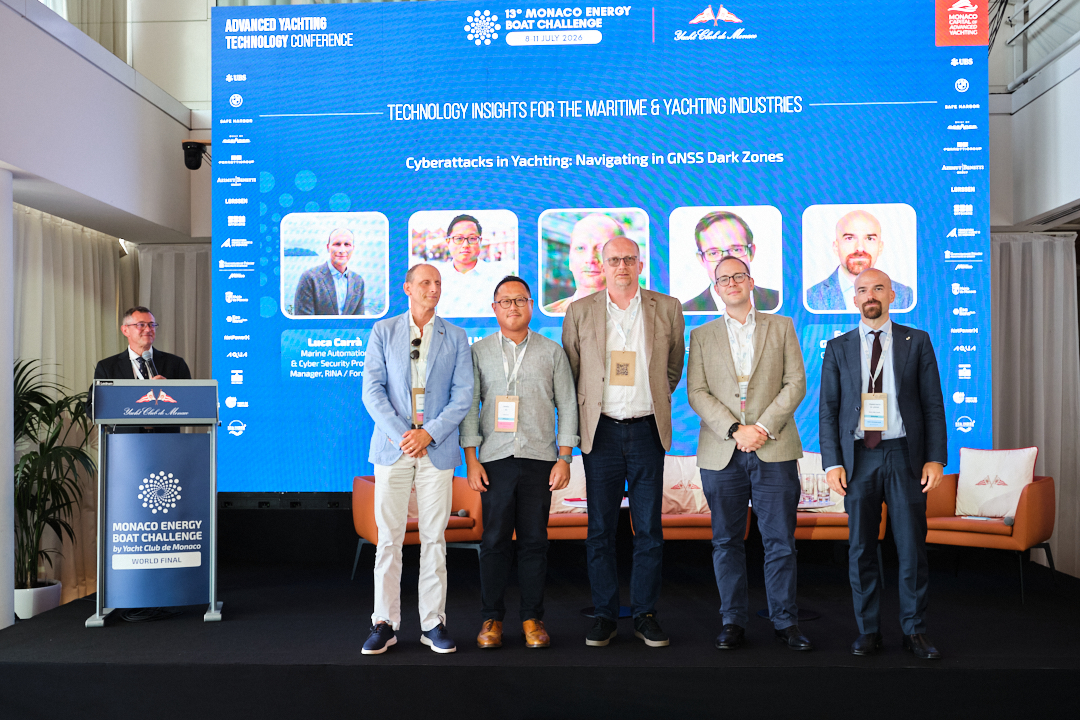
À mesure que les yachts multiplient les systèmes connectés, la cybersécurité devient un sujet à part entière. Les intervenants ont rappelé que les menaces ne relèvent plus uniquement de scénarios théoriques. Brouillage et usurpation des signaux GNSS, attaques informatiques classiques, segmentation des réseaux de bord ou encore conservation des preuves numériques : autant de sujets qui devront désormais être intégrés dès la conception des navires. Les échanges se sont d’abord concentrés sur les interférences visant les systèmes de navigation par satellite. Francisco Gallardo López, GNSS Resilience Lead chez DLR GfR, a rappelé que ces phénomènes ne relevaient plus de l’anticipation mais de la réalité opérationnelle. Il a notamment évoqué les travaux récents démontrant qu’une interférence pouvait désormais être émise depuis l’espace. « Cela signifie que l’ensemble du réseau GNSS pourrait être brouillé ou falsifié sur tout le continent en ce moment même. » Il a insisté sur les outils disponibles pour renforcer la résilience des systèmes européens.
Pour Daniel Ng, CEO de CyberOwl, il convient toutefois de replacer ces risques dans leur contexte. Si les interférences GNSS se multiplient, les attaques ayant aujourd’hui le plus d’impact sur les navires restent les cyberattaques plus classiques. « La grande majorité des incidents cybernétiques qui ont réellement des répercussions sur les ports restent principalement ce que l’on appelle les attaques traditionnelles de cybersécurité, plutôt que des interférences directes avec le GNSS. » Selon lui, les premiers efforts doivent donc porter sur les fondamentaux de la cybersécurité. « Si nous devions investir dès aujourd’hui pour prendre des mesures concrètes en matière de cybersécurité, je commencerais par examiner très attentivement vos réseaux et par mettre en place une certaine forme de ségrégation des données. »
Même constat chez Andrzej Gab, cofondateur d’Ogmios Maritime. Selon lui, les super-yachts concentrent aujourd’hui de très nombreux objets connectés et accueillent continuellement de nouveaux utilisateurs, ce qui accroît mécaniquement leur surface d’exposition. « Un super-yacht, c’est un smartphone flottant, regorgeant d’appareils et d’objets connectés à Internet, souvent reliés entre eux au sein d’un même réseau. » Il estime que le secteur souffre encore d’un déficit de cyber-culture. « Nous devons sensibiliser les gens à cette question. »
Pour Luca Carrà, Marine Automation & Cyber Security Product Manager chez RINA / Foreship, la cybersécurité ne peut plus être traitée uniquement au stade de la certification. Elle doit être intégrée dès la conception du navire et accompagnée d’une meilleure compréhension des systèmes installés à bord. « Si vous savez à quoi vous avez affaire, vous saurez sans doute comment réagir. Si vous ne le savez pas, il est probablement presque impossible de comprendre ce qui se passe. » Il plaide notamment pour une documentation complète des architectures numériques embarquées. « Une sorte de « cyber-passeport » du système numérique installé à bord. »
Enfin, Henry Clack, Senior Associate chez HFW, a rappelé que la gestion d’une cyberattaque ne relevait pas uniquement de la technique mais également du droit et de l’assurance. Selon lui, la préservation des données constitue une étape essentielle après un incident. « La conservation des preuves est l’un des premiers messages que nous transmettons à un propriétaire. » Il met également en garde contre une réaction fréquente des équipages. « Si, par exemple, l’équipage réinitialise le matériel et efface ces journaux de bord, nous nous retrouvons alors dans une situation nettement plus difficile pour tenter de les aider et de les protéger que s’ils avaient conservé ces informations. »
Au terme des échanges, un consensus s’est dégagé : à mesure que les yachts deviennent plus numériques, leur sécurité ne dépend plus uniquement de la robustesse de leurs équipements, mais aussi de la qualité de leur architecture informatique, de la formation des équipages et de leur capacité à détecter rapidement une anomalie avant qu’elle ne produise des conséquences opérationnelles.
On Friday 10 July, the Monaco Energy Boat Challenge continues the dialogue at the 7th Alternative Fuels & Sustainable Yachting Conference, jointly organised by Yacht Club de Monaco and the Prince Albert II of Monaco Foundation. The focus will be on hydrogen, refuelling infrastructure, nuclear propulsion, wind power, batteries, and electrification, the shared aim being to identify technological solutions capable of accelerating decarbonisation of the maritime sector.
Share: